Introduction
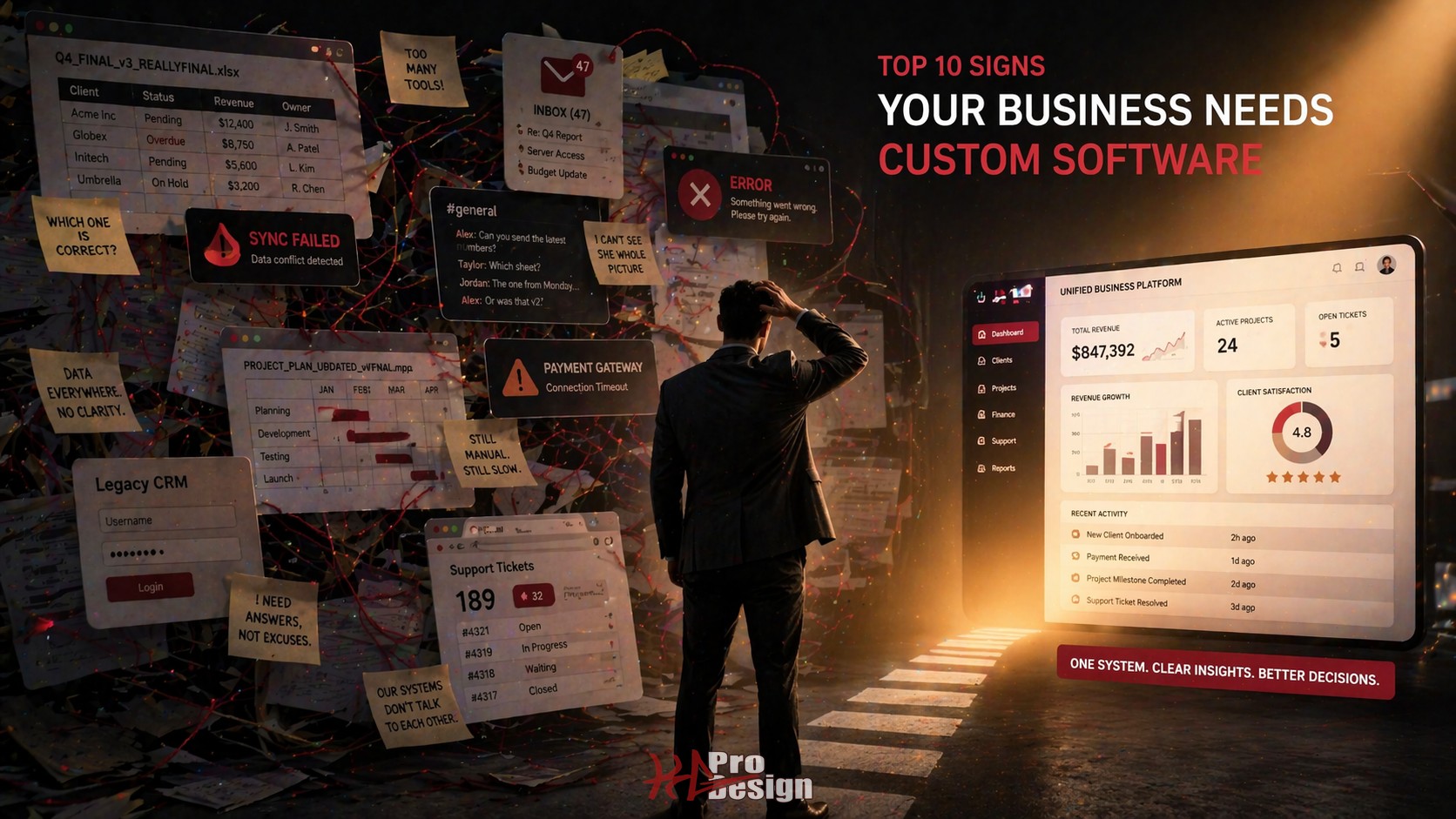
SaaS fatigue is real. If your business is anything like the ones we work with, you are paying for five, ten, maybe fifteen different software subscriptions right now. Each one solves a slice of a problem. None of them talk to each other without duct tape and a prayer. And every month, the invoices keep coming.
There is nothing inherently wrong with off-the-shelf software. For commodity tasks like email, file storage, and basic accounting, SaaS platforms are efficient and cost-effective. But there is a tipping point where stacking more subscriptions stops being a solution and starts being the problem.
We have spent over eighteen years helping businesses recognize that tipping point. In this article, we will walk through ten clear signs that your business has outgrown off-the-shelf tools and is ready for custom software. If you have already started thinking about the financial side of this decision, we covered that in depth in our piece on the ROI of custom software development.
The 10 Signs
1. You Are Paying for Features You Do Not Use
Most enterprise SaaS platforms are built to serve the broadest possible audience. That means you are paying for a massive feature set when you only use a fraction of it. If your team uses ten percent of a platform that costs two hundred dollars per month, you are effectively paying twenty dollars per feature per month for the features that actually matter.
Custom software eliminates this waste entirely. You pay to build exactly what you need, nothing more. Over time, the savings compound because you are not subsidizing features designed for someone else's business.
2. Your Team Uses Workarounds Daily
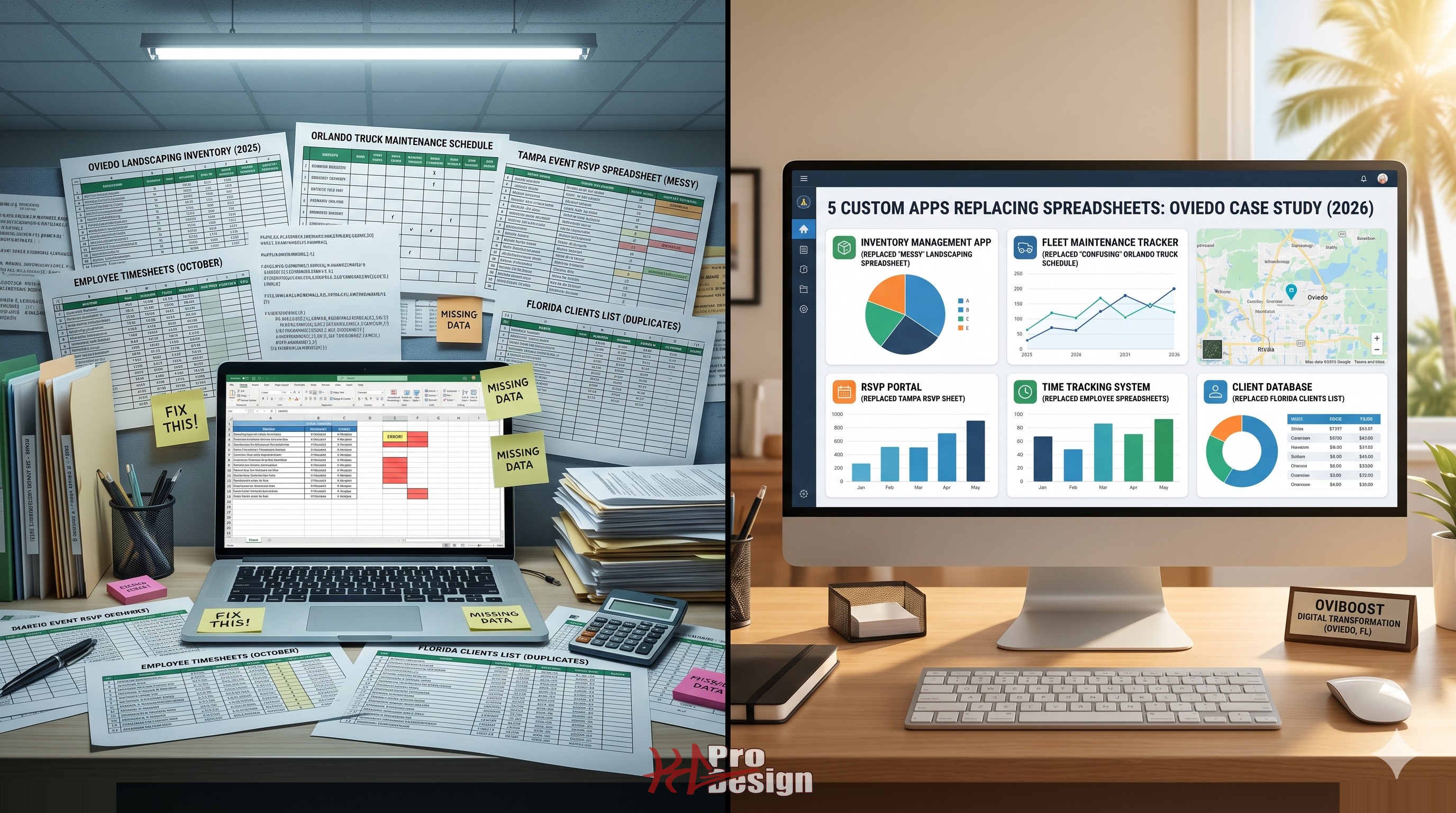
Pay attention to how your employees actually work. Are they maintaining side spreadsheets to track information your CRM cannot handle? Are they copying and pasting data between systems? Are they sending themselves email reminders because the software lacks proper notifications?
Workarounds are symptoms of a process-software mismatch. Every workaround represents a place where your tools have failed to support how your business actually operates. A few workarounds are normal. A culture built on workarounds is a sign that your software is working against you, not for you.
3. You Are Duct-Taping Multiple Tools Together
Zapier chains. Make (formerly Integromat) scenarios. IFTTT recipes. Manual data entry between systems because no integration exists. If you have built an elaborate web of automations to get your tools to communicate, you have effectively built custom software already, just with someone else's unreliable components.
These integrations break. APIs change without notice. Rate limits get hit during peak hours. And when a single link in the chain fails, it can take hours to trace the problem. In many cases, the total cost of building and maintaining these integrations exceeds what custom development would have cost in the first place.
4. Your Data Lives in Silos
Customer information in the CRM. Financial data in the accounting software. Operational metrics in spreadsheets. Project details in a project management tool. Marketing analytics in yet another dashboard.
When your data lives in silos, decision-making suffers. You cannot get a complete picture of a customer's relationship with your business without logging into three different platforms and mentally stitching the information together. A unified custom system gives you a single source of truth, which means faster decisions and fewer blind spots.
5. You Have Outgrown Your Current Solution
Growth is supposed to be a good thing, but your software vendor might disagree. Hitting user limits means upgrading to a more expensive tier. Storage caps force you to archive data you still need. API rate limits throttle the integrations you depend on during your busiest hours.
Your business growth should never be throttled by a vendor's pricing model. Custom software scales with you because you control the infrastructure. Adding ten more users does not trigger a pricing conversation. It just works.
6. Compliance Requirements Are Getting Complex
Industries like healthcare, finance, and government contracting have strict compliance requirements. HIPAA demands specific controls over how patient data is handled. PCI-DSS governs payment card data. SOC 2 requires demonstrable security practices.
Generic SaaS tools may check some compliance boxes, but they rarely cover all of them in a way that survives an audit. Custom software lets you build compliance into the architecture from day one rather than bolting it on as an afterthought. If your compliance landscape is getting complicated, a technology consulting engagement can help you map the requirements before building anything.
7. You Need a Competitive Advantage
Here is an uncomfortable truth: if you and your competitors are using the same SaaS tools with the same configurations, you have the same limitations. You are competing on execution alone, with identical constraints.
Custom software can become a genuine competitive moat. A proprietary tool that automates a process your competitors handle manually gives you a speed advantage. A customer-facing portal tailored to your specific workflow creates a better experience than anything a generic platform can offer. When your software is built for your business, it becomes part of what makes your business hard to replicate.
8. Customer Experience Is Suffering
Slow customer portals. Clunky interfaces that require a manual to navigate. Limited self-service options because the platform was not designed for your customer journey. If your customers are frustrated by the tools you are asking them to use, you are losing business to competitors who have invested in better experiences.
Custom software lets you design the customer experience from scratch, built around how your customers actually want to interact with your business. No compromises, no "that feature is on our roadmap" responses from a vendor who has a thousand other customers to consider.
9. You Are Spending More Time Managing Software Than Using It
Software is supposed to save time. But if your team is spending significant hours each week on admin tasks like managing user permissions, troubleshooting integration failures, coordinating vendor upgrades, and attending training sessions for the latest UI changes, the tool has become the job.
This is particularly common when businesses stack multiple SaaS products. Each one has its own admin console, its own update cycle, its own support channel, and its own learning curve. The cumulative overhead can be staggering. Custom software consolidates this into a single system under your control with update schedules that fit your business, not the vendor's roadmap.
10. You Have a Unique Business Process
This is the most fundamental sign on the list. If your business process is your differentiator, the thing that makes you better than your competitors, then forcing that process into a one-size-fits-all tool is actively working against your advantage.
Generic software assumes generic workflows. If your workflow is generic, that is fine. But if the way you onboard clients, fulfill orders, manage projects, or deliver services is genuinely unique, your software should reflect that uniqueness, not flatten it into someone else's template.
When SaaS Is Still the Right Choice
We are not anti-SaaS. There are plenty of situations where off-the-shelf software is the smarter choice.
- Commodity functions: Email, basic accounting, file storage, and video conferencing are well-served by existing platforms. Building custom versions of these tools rarely makes sense.
- Standard workflows: If your process follows industry norms without significant customization, a proven SaaS solution is faster to deploy and easier to maintain.
- Temporary or experimental projects: If you are testing a new business line or running a short-term initiative, a SaaS tool gets you moving quickly without a large upfront investment.
The key is being honest about where you fall on this spectrum. Not every problem needs custom software. But when the signs above start stacking up, the cost of not building something custom starts outweighing the cost of doing so.
How to Get Started with Custom Software
The transition from SaaS to custom software does not have to be all-or-nothing. In fact, we typically recommend a phased approach.
Start with an assessment. Identify which systems are causing the most friction, costing the most money, or creating the most risk. Prioritize based on business impact, not technical complexity.
Define the scope clearly. Custom software fails when the scope is vague. Before writing a single line of code, you need a clear understanding of what the software must do, who will use it, and how success will be measured.
Build iteratively. Launch with core functionality first. Get real users into the system. Gather feedback. Then expand. This reduces risk and ensures you are building something people actually use.
If you are considering custom software development for your business, the first step is a conversation about where your current tools are falling short and what a custom solution could look like.
Ready to Move Beyond SaaS?
If you recognized your business in three or more of the signs above, it is worth exploring what custom software could do for you. The upfront investment is real, but so are the long-term savings, the competitive advantage, and the elimination of the daily friction your team is living with.
Contact us to schedule a discovery call. We will help you evaluate whether custom development makes sense for your situation, and if it does, map out a plan to get there.