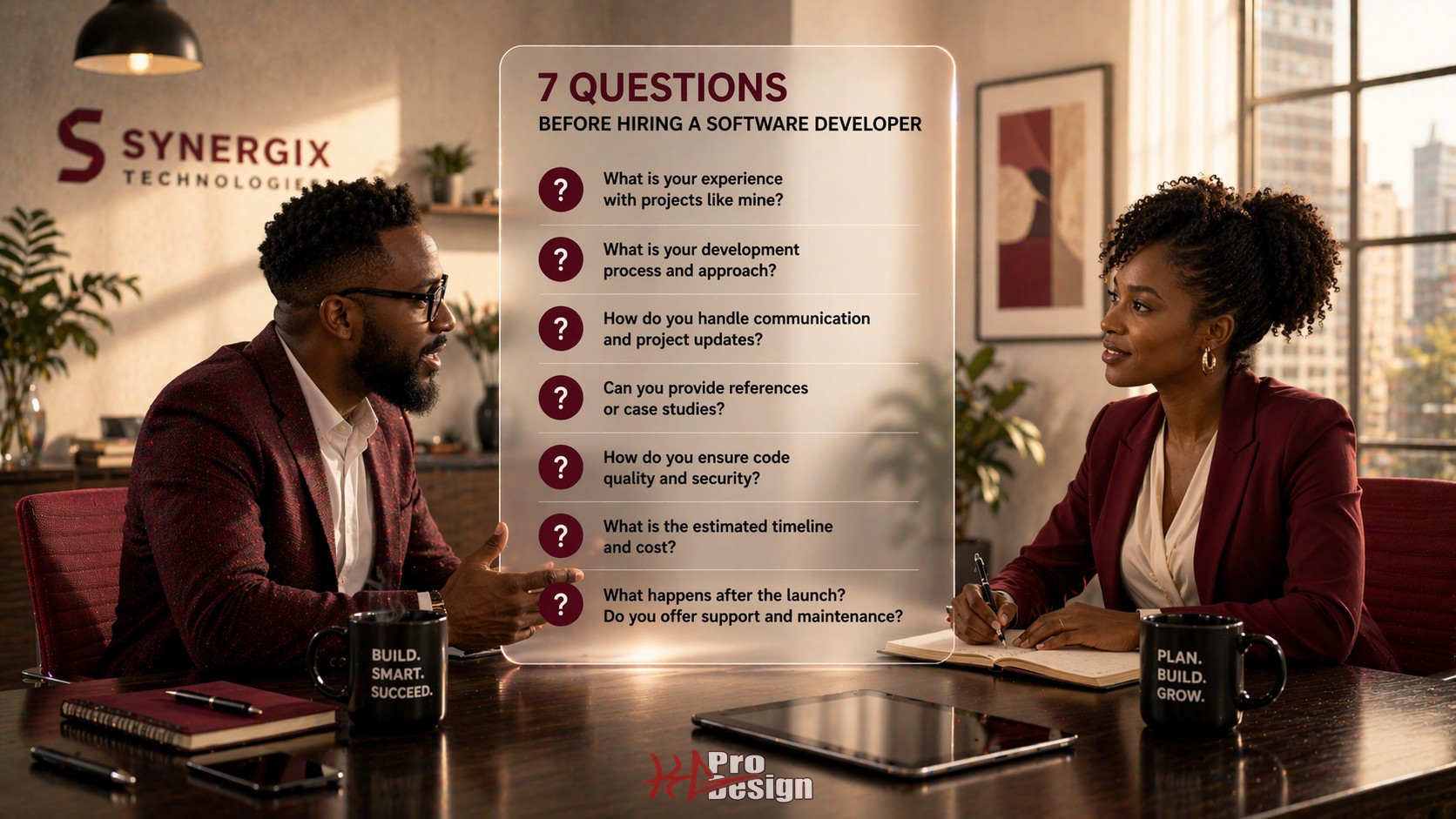
Introduction
Hiring the wrong software developer can cost several times the original project budget in rework, delays, and opportunity cost. The initial engagement goes off the rails, the code is unusable or unmaintainable, and you end up paying someone else to start over from scratch. We have seen it happen more times than we can count.
The challenge is that most business owners are not engineers. They are evaluating technical talent without the technical background to know what good looks like. That asymmetry is exactly what leads to expensive mistakes.
These seven questions are designed to close that gap. They are not gotcha questions or trick interviews. They are practical, straightforward questions that any competent developer should be able to answer clearly. The quality of the answers will tell you more about a developer's reliability than any portfolio screenshot ever could.
The 7 Questions
1. Can You Show Me Similar Projects You Have Built?
This is the most important question on the list, and it should be the first one you ask. A developer's portfolio is the single best predictor of whether they can deliver what you need.
What a good answer looks like: The developer walks you through two or three projects that share meaningful similarities with yours. They explain the business problem, the technical approach, and the outcome. They can speak to the challenges they faced and the tradeoffs they made. They may offer to connect you with the client.
What a bad answer looks like: Vague references to "similar work" without specifics. A portfolio of visually impressive sites that have nothing to do with your project type. Claims of extensive experience with no evidence to back them up.
Why it matters: Building an e-commerce platform is fundamentally different from building a healthcare portal. A developer who has built ten beautiful marketing websites may be completely out of their depth with a complex business application. Industry-relevant experience is not a bonus; it is a requirement.
Take a look at our portfolio to see how we present our project work. A credible developer should be able to show you something similar, with context about the problem they solved.
2. What Technology Stack Will You Use and Why?
The technology choices behind your software will affect its performance, maintainability, and long-term cost for years after launch. You need a developer who selects tools based on your project's needs, not their personal preferences.
What a good answer looks like: The developer recommends a specific stack and explains why it fits your project. They discuss tradeoffs. They can articulate why they chose one framework over another based on your requirements, such as scalability needs, team capabilities, or integration requirements. If you are curious about how technology stack decisions work, we wrote a detailed guide on choosing the right technology stack.
What a bad answer looks like: "We use [framework X] for everything." A developer who uses the same stack regardless of the project is either limited in their capabilities or not thinking critically about your specific needs. Another red flag is a developer who recommends the most cutting-edge technology without justifying why it is appropriate for your use case. New does not always mean better.
Why it matters: Technology decisions made at the beginning of a project are expensive to change later. The wrong database choice can create performance problems at scale. The wrong framework choice can make it difficult to find developers for maintenance down the road. You want someone who thinks about these implications upfront.
3. How Do You Handle Project Changes and Scope Creep?
Every software project encounters changes. Requirements evolve. Users provide feedback that shifts priorities. Market conditions change. The question is not whether changes will happen, but how they will be managed when they do.
What a good answer looks like: The developer has a clear, documented process for change requests. They explain how changes are evaluated for impact on timeline and budget. They discuss their approach to agile development, where priorities can shift between sprints without derailing the entire project. They are transparent about the tradeoff between fixed-bid and time-and-materials pricing models.
What a bad answer looks like: "We'll figure it out as we go." Or worse, "the original scope is the original scope," with no flexibility built in. Both extremes are problematic. A developer with no change process will let scope creep silently inflate your budget. A developer with no flexibility will deliver exactly what you asked for three months ago, even though your needs have evolved.
Why it matters: Scope creep is the number one budget killer in software development. A developer with a mature change management process protects you from surprises while still allowing the project to adapt to new information.
4. What Happens After Launch?
Software is not a "build it and forget it" asset. It needs maintenance, security updates, bug fixes, and periodic enhancements. A developer who treats launch as the finish line is leaving you in a vulnerable position.
What a good answer looks like: The developer outlines their post-launch support options. They discuss maintenance plans, bug fix response times, and how they handle security patches. They talk about knowledge transfer and documentation so your team (or a future developer) can understand and maintain the system. They have defined SLAs (service level agreements) for response times and issue severity levels.
What a bad answer looks like: Radio silence on the topic. Or a vague "we'll be around if you need us" without any structured plan. If a developer does not proactively address post-launch support, they are either planning to disappear or they have not thought it through. Neither is reassuring.
Why it matters: The most critical bugs tend to appear after launch, when real users interact with the system in ways testing did not anticipate. You need to know that your developer will be responsive when those issues arise, and what that responsiveness will cost.
5. Who Owns the Code?
This question has derailed more client-developer relationships than almost any other. Intellectual property ownership must be crystal clear before a single line of code is written.
What a good answer looks like: "You do. The contract explicitly states that all custom code developed for your project is your property upon payment. You will have full access to the code repository, deployment credentials, and documentation. We do not hold your code hostage."
What a bad answer looks like: Hedging, deflecting, or claiming that ownership is "complicated." Any developer who is reluctant to grant you full ownership of code you paid for is setting you up for vendor lock-in. Some developers retain ownership so that you cannot leave without losing your software. This is a major red flag.
Why it matters: If you do not own your code, you are renting it. That means you cannot switch developers without starting over. You cannot hire an internal team to take over maintenance. You are locked into a relationship that may not serve your interests long-term. IP ownership should be non-negotiable.
6. How Do You Communicate During Development?
Communication breakdowns are responsible for more project failures than technical problems. A developer can be technically brilliant and still deliver a terrible outcome if they cannot communicate effectively with your team.
What a good answer looks like: The developer describes a structured communication cadence. Weekly status meetings, written progress reports, and access to a project management tool where you can see tasks, timelines, and blockers in real time. They set expectations for response times on emails and messages. They are proactive about raising issues before they become crises.
What a bad answer looks like: "We'll keep you updated." No specifics on frequency, format, or tools. If the developer seems uncomfortable with the idea of regular check-ins, or if they prefer to disappear for weeks at a time and resurface with a "big reveal," be cautious. Software development is not a magic show. You should be able to see progress continuously.
Why it matters: The more visibility you have into the development process, the earlier you can catch misunderstandings, redirect efforts, and ensure the final product matches your expectations. Developers who resist transparency are either disorganized or hiding problems. Neither is acceptable.
7. Can You Provide References from Past Clients?
Portfolios show you what a developer built. References tell you what they were like to work with. Both pieces of information are essential.
What a good answer looks like: The developer provides two or three references from recent clients whose projects are similar in scope to yours. They encourage you to call, not just email. They are confident that their references will speak positively about the experience.
What a bad answer looks like: Reluctance to provide references. References that are years old or from projects with no resemblance to yours. Testimonials on a website are a start, but they are curated. Talking to an actual client gives you unfiltered feedback.
When you talk to references, ask these specific questions:
- Did the project stay on budget and on schedule?
- How did the developer handle unexpected problems?
- Would you hire them again?
- What was the biggest challenge in the engagement?
That last question is the most revealing. Every project has challenges. How the developer handled those challenges tells you what your experience will be like.
Red Flags to Watch For
Beyond the answers to these seven questions, keep an eye out for these warning signs.
- No portfolio or references: If a developer cannot show past work or connect you with past clients, proceed with extreme caution.
- Unrealistically low estimates: If one developer quotes half of what everyone else is quoting, they are either cutting corners, underestimating the work, or planning to make it up with change orders later.
- No written contract or statement of work: A handshake agreement is not a contract. You need a written document that specifies scope, timeline, deliverables, payment terms, and IP ownership.
- Resistance to milestone-based payments: Paying everything upfront gives the developer no incentive to deliver on time. Milestone-based payments align incentives and reduce your financial risk.
- Technology name-dropping without substance: Buzzwords are not a substitute for understanding. If a developer talks about "leveraging blockchain and AI" without explaining specifically how those technologies solve your problem, they are selling hype, not solutions.
How KG ProDesign Answers These Questions
We believe in transparency, so here is how we approach each of these areas.
Portfolio: We maintain a detailed portfolio of our work across industries, including software development, web design, and automation projects.
Technology stack: We evaluate each project independently and recommend the stack that best fits the requirements. We specialize in React and TypeScript for frontend development and modern cloud architectures for backend systems, but our recommendations are always driven by the problem, not our preferences.
Change management: We use agile methodology with clear sprint cycles. Change requests are evaluated for impact and discussed openly before any commitment is made.
Post-launch support: Every project includes a defined support period after launch. We offer ongoing maintenance agreements for clients who want continued partnership.
Code ownership: You own everything we build for you. Full stop.
Communication: Weekly status updates, access to project management tools, and a direct line to the development team. We do not disappear.
References: We are happy to connect you with past clients. We have built long-term relationships with businesses across multiple industries, and our clients are willing to talk about their experience.
Learn more about our approach to software development, or reach out directly to start a conversation about your project.
Ready to Find the Right Developer?
Hiring a software developer is a significant decision with long-term implications for your business. The right partner will save you time, money, and frustration. The wrong one will cost you all three.
Use these seven questions as your evaluation framework. The developers who answer them well are the ones worth working with. The ones who stumble, hedge, or dodge are the ones to avoid.
Get in touch with us to schedule a discovery call. We will answer every one of these questions and any others you have, because that is what a trustworthy development partner does.