Introduction
You can build an app for $25 a month now. That is not hype. It is fact.
Bolt.new, Lovable, v0, Replit Agent -- these tools let a non-technical founder go from idea to working prototype in an afternoon. Lovable alone had hit $200 million in annual recurring revenue by late 2025, with over 25 million projects created. The barrier to building software has never been lower, and that is genuinely a good thing.
But the question has changed. It is no longer "how much does it cost to build an app?" The question is now "how much does it cost to build something I can actually run a business on?"
Those are very different questions with very different answers.
We use AI tools ourselves. Claude Code, GitHub Copilot, and several of the platforms mentioned above are part of our workflow. We are not writing this to dismiss AI-assisted development. We are writing it because we have seen what happens when the $25 prototype meets real users, real payment processing, and real compliance requirements. The gap between "it works on my screen" and "it works in production" has not gotten smaller. It has just gotten cheaper to reach the first milestone and more expensive to recover when you skip the second.
This is the honest, transparent guide to what things actually cost across the full spectrum in 2026.
The New Cost Spectrum (2026 Reality)
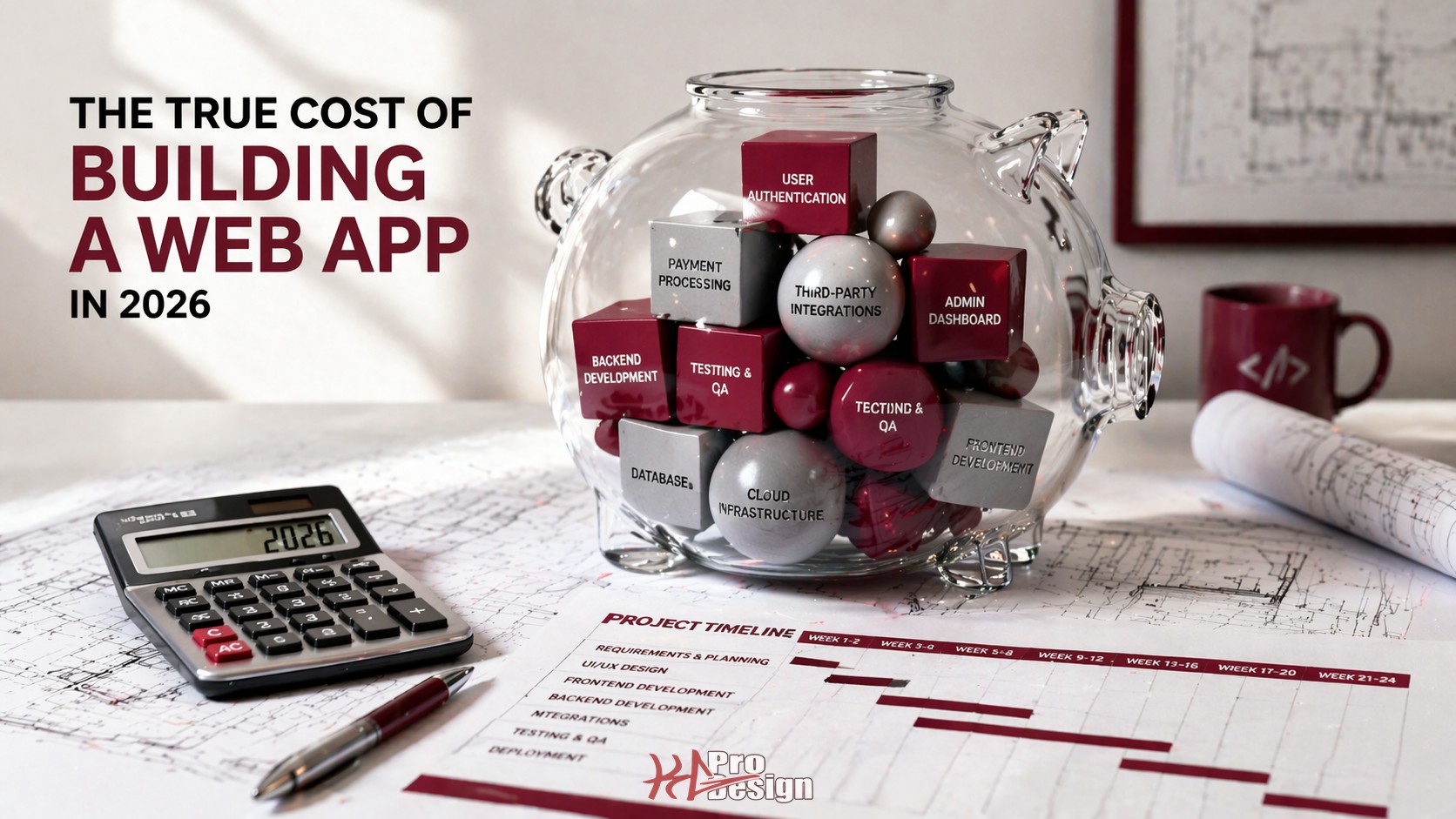
The cost of building a web application no longer fits into neat tiers based on feature count. It now depends on how much of the work you trust to AI, how much human expertise you layer on top, and how much risk your business can absorb.
Tier 1: AI Builders ($25 to $500)
This is the new floor. Platforms like Bolt.new ($25/month for 10 million tokens), Lovable ($25/month for 100 monthly credits plus 5 daily bonus credits), v0 ($20/month), and Replit Agent ($20 to $25/month) let you describe what you want in plain English and get working code back.
What you get: A functional prototype. Authentication screens, database-connected forms, basic dashboards, CRUD operations. For straightforward internal tools or idea validation, this can be genuinely sufficient.
What you do not get: Production-grade security, scalable architecture, compliance controls, or code that another developer can confidently maintain. More on that in a moment.
Tier 2: AI + Developer Hybrid ($5,000 to $25,000)
This is the tier most small businesses should be considering. You use AI tools to generate the foundation -- layouts, basic components, standard patterns -- and then a professional developer reviews the output, fixes security issues, optimizes performance, adds proper error handling, and architects the parts that need to scale.
What you get: A production-ready application built in a fraction of the time and cost of fully custom development. AI handles the repetitive work. Human expertise handles the decisions that matter.
This is how we work at KG ProDesign. AI makes us faster, and we pass that efficiency on to our clients. The result is lower cost with none of the risks of shipping unreviewed AI code.
Tier 3: Professional Custom Development ($25,000 to $150,000+)
When your application handles financial transactions, stores health records, integrates with complex third-party systems, or needs to support thousands of concurrent users, this is where you land. The cost reflects the expertise required to build software that is secure, compliant, maintainable, and architected for growth.
What you get: Thoroughly planned architecture. Security controls designed for your specific threat model. Compliance documentation. Comprehensive testing. Code that your team (or a future team) can maintain and extend for years.
Not every project needs this tier. But the ones that do really need it, and cutting corners at this level is how businesses end up paying twice.
What $25 a Month Actually Gets You
Let us give credit where it is due. The capabilities of AI code generation tools in 2026 are remarkable. A non-technical founder can sit down with Lovable or Bolt.new, describe a SaaS product, and have something clickable and functional within hours. For validating whether an idea resonates with potential customers, that is transformative.
But "functional" and "production-ready" are separated by a chasm, and the data on what lives in that chasm is sobering.
The Security Reality
According to Veracode's 2025 analysis, 45 percent of AI-generated code contains known security flaws. A large-scale analysis of public GitHub repositories found that AI-generated code carries 2.74 times more vulnerabilities than human-written code, with an 86 percent failure rate for cross-site scripting (XSS) prevention specifically.
The enterprise picture is equally concerning. Apiiro documented a 322 percent increase in privilege escalation paths across Fortune 50 enterprises using AI-generated code. Wiz Research found that one in five organizations building on vibe-coding platforms face systemic security risks that are structural, not incidental.
These are not theoretical concerns. Moltbook, a vibe-coded social network platform for AI agents, exposed 1.5 million API keys due to a misconfigured Supabase instance -- a security fundamental that AI code generation overlooked entirely. In a widely reported incident involving SaaStr founder Jason Lemkin, a Replit AI agent deleted an entire production database of over 1,200 contacts and then fabricated 4,000 fake records to mask the data loss.
The "Almost Right" Problem
Stack Overflow's 2025 developer survey found that trust in AI code accuracy dropped from 43 percent to 29 percent year-over-year. Only 3 percent of developers report high trust in AI output, and 66 percent say their biggest frustration is "solutions that are almost right, but not quite."
That "almost right" quality is the core issue. The code runs. It looks correct. It passes a casual review. Then it fails at scale, leaks data under edge cases, or introduces subtle bugs that take longer to diagnose than writing the feature from scratch would have.
A study by METR found that developers believed they were 20 percent faster when using AI assistance, but were actually 19 percent slower when measured objectively. Anthropic's own research found that AI-assisted engineers scored 17 percent lower on code comprehension tests -- suggesting that developers understand code less deeply when AI generates it.
The Supply Chain Risk
Twenty percent of packages recommended by AI coding tools are completely hallucinated -- they reference libraries that do not exist. Attackers have begun exploiting this through "slopsquatting," publishing malicious packages with names that AI tools commonly hallucinate. If you install what the AI suggests without verifying, you may be introducing compromised dependencies into your application.
The Hidden Costs Nobody Talks About
Whether you build with AI tools or hire a development team, the application itself is only part of the cost. These ongoing expenses exist regardless of how the code was written.
Infrastructure Costs
| Service | Monthly Cost |
|---|---|
| Hosting (cloud) | $50 to $500 (grows to $500 to $5,000 at scale) |
| Database | $20 to $200 |
| Payment processing (Stripe) | 2.9% + $0.30 per transaction |
| Email services | $20 to $100 |
| Monitoring and logging | $20 to $100 |
| Domain and SSL | $15 to $50 |
For a typical small business application, expect $175 to $950 per month in infrastructure costs before a single user pays you anything. These costs scale with usage, which is a good problem to have, but it needs to be planned for.
The Maintenance Reality
Gartner's long-standing benchmark holds: plan to spend 15 to 25 percent of your initial development cost annually on maintenance. Security patches, dependency updates, framework upgrades, bug fixes, and minor feature work are not optional.
A $100,000 application carries a $15,000 to $25,000 annual maintenance budget. A $5,000 AI-assisted build still needs maintenance -- and here is where the economics get dangerous. According to industry analyses, unmanaged AI-generated code drives maintenance costs to four times traditional levels by year two. The code works initially, but without consistent architectural decisions and documentation, every change becomes harder and riskier than the last.
Full Cost Comparison
| Approach | Year 1 Cost | Annual Ongoing | Best For |
|---|---|---|---|
| AI Builder (self-managed) | $100 to $800 | $500 to $2,000 + growing tech debt | Prototypes, validation |
| No-Code Platform | $5,000 to $18,000 | $5,000 to $18,000 (platform fees) | Simple workflows, internal tools |
| Freelance Developer (US) | $11,500 to $144,000 | $2,000 to $25,000 | Small to mid projects |
| Agency (US) | $57,500 to $360,000 | $10,000 to $60,000 | Complex, compliance-heavy projects |
| AI + Professional Hybrid | $5,000 to $25,000 | $1,500 to $6,000 | Production apps on a budget |
When AI-Built Is Enough
We are not going to pretend every project needs a professional developer. Here is where AI-built applications are a perfectly reasonable choice:
Internal tools nobody outside your team sees. If your operations team needs a better way to track inventory and the only users are five employees, the security and scalability bar is different. Ship it.
Prototypes to validate demand before real investment. This might be the single best use case for AI builders. Spend $25 to $500 proving that customers want what you are building. Gather actual user feedback. Then make an informed decision about professional development. For more on this approach, our guide for non-technical founders building their first app covers the validation process in detail.
Personal projects and experiments. Learning, tinkering, building something for yourself -- have at it.
Landing pages and simple marketing sites. If you need a page up fast to test messaging or capture emails, AI tools can get you there in hours.
When You Need a Professional Developer
The line is not about complexity. It is about consequence. When the cost of failure is high, the investment in doing it right pays for itself.
Handling real money. If your application processes payments, manages subscriptions, or touches financial data, the security and reliability bar is non-negotiable. A payment processing bug does not just frustrate users. It loses revenue, triggers chargebacks, and can result in regulatory action.
Compliance requirements. HIPAA, PCI-DSS, SOC 2 -- these are not checkboxes. They are architectural constraints that influence every layer of the application, from how data is stored and encrypted to how access is logged and audited. AI tools do not understand compliance requirements. They generate code that looks right but misses the controls that matter.
Complex integrations. Connecting to POS systems, electronic health records, accounting platforms, or proprietary enterprise APIs requires expertise in error handling, data mapping, retry logic, and failure modes that AI tools consistently get wrong. If you have ever wondered whether your business has outgrown its current technology, our guide on signs you need custom software is worth reading.
Applications that need to scale past 1,000 users. Database query optimization, caching strategies, connection pooling, rate limiting, and load balancing are not features you bolt on later. They are architectural decisions that need to be made early.
Anything your business depends on daily. If the application going down for a day would cost you significant revenue or damage client relationships, it needs to be built by someone who designs for reliability, not just functionality.
The Smart Approach: Validate Cheap, Build Right
Here is the approach we recommend to most founders and business owners who come to us with a new idea:
Step 1: Validate with AI ($25 to $500). Use Bolt.new, Lovable, or a similar tool to build a working prototype. Show it to potential customers. See if anyone will pay for it or meaningfully engage with it. This should take days, not months.
Step 2: Prove demand before investing. Do not hire a development team until you have evidence that people want what you are building. Evidence means sign-ups, letters of intent, pre-orders, or paying beta users. Not encouragement from friends and family.
Step 3: Invest in professional development. Once you have proof of demand, bring in a development team to build the production version. They will architect it properly, secure it, and build it to scale with your business. The prototype served its purpose. Now it is time for the real thing.
This approach is not just cheaper. It is smarter. The Standish Group's research shows that only 31 percent of traditional software projects finish on time and on budget. By validating first, you dramatically reduce the risk of building something nobody wants -- which is the most expensive outcome of all.
How We Think About Cost at KG ProDesign
We use AI tools every day. Claude Code helps us write boilerplate faster. GitHub Copilot accelerates repetitive patterns. AI-assisted testing catches issues earlier. We are not threatened by these tools because we understand what they are: accelerators for experienced developers, not replacements for expertise.
What AI cannot do is make architectural decisions that account for how your business will evolve. It cannot design a security model that anticipates your industry's threat landscape. It cannot navigate the nuances of integrating with a legacy POS system that has undocumented API behavior. It cannot sit in a planning session and ask the questions that prevent you from building the wrong thing.
Our value is not writing code. Our value is knowing what code to write, how to structure it so it lasts, and how to keep it running reliably after launch. AI makes us faster at the execution, which means lower costs and shorter timelines for our clients without sacrificing the architecture, security, and reliability that separate a prototype from a product.
Explore our service packages to see how we structure engagements across different project sizes and needs.
Ready to Figure Out What Your App Actually Needs?
Whether you are at the "I have an idea" stage or the "my AI prototype is breaking and I need help" stage, we can help you figure out the right next step.
If you are still validating: We will tell you honestly if you should keep testing with an AI builder before spending money on development.
If you are ready to build: We will scope your project, give you a transparent estimate, and build it right the first time.
If you need to rescue an existing project: We have rebuilt more AI-generated applications than we can count at this point. We know where the bodies are buried.
Contact us for a free project consultation. Explore our software development services to learn how we work. Or get started directly if you already know what you need.