Introduction
Artificial Intelligence (AI) and Machine Learning (ML) are no longer future technologies—they're transforming businesses today. In 2026, AI-powered automation is delivering measurable results across industries, from customer service to operations management.
This article explores practical AI applications that are delivering real ROI, with examples you can implement in your own business.
The State of AI Automation in 2026
AI automation has evolved from experimental to essential:
- 80% of enterprises now use AI in some form
- Average ROI of 3-5x within the first year
- Automation of 40-60% of routine tasks in AI-adopting companies
The difference? Focusing on practical applications rather than chasing hype.
Key Areas Where AI Delivers ROI
1. Customer Service Automation
AI-Powered Chatbots and Support:
Modern AI chatbots go far beyond scripted responses:
- Natural language understanding
- Context-aware conversations
- Seamless handoff to human agents when needed
- 24/7 availability
Real Impact:
- 70% reduction in response time
- 40% decrease in support costs
- 90% customer satisfaction for automated interactions
2. Document Processing and Data Extraction
Intelligent Document Processing (IDP):
AI can extract, classify, and process documents automatically:
- Invoice processing
- Contract analysis
- Form data extraction
- Compliance checking
Use Case Example:
A finance department processing 10,000 invoices monthly:
- Manual processing: 5 minutes per invoice = 833 hours/month
- AI-powered processing: 30 seconds per invoice = 83 hours/month
- Savings: 750 hours monthly or $37,500/month at $50/hour
3. Predictive Analytics
Anticipating Problems Before They Occur:
AI models can predict:
- Equipment failures (predictive maintenance)
- Customer churn
- Inventory needs
- Market trends
Manufacturing Example:
Predictive maintenance reduces:
- Unplanned downtime by 50%
- Maintenance costs by 30%
- Equipment lifespan extended by 20%
4. Intelligent Process Automation (IPA)
Beyond Simple RPA:
IPA combines RPA with AI to handle complex, judgment-based tasks:
# Example: AI-powered invoice approval workflow
from sklearn.ensemble import RandomForestClassifier

class InvoiceApprovalAI:
    def __init__(self):
        self.model = self.load_trained_model()

    def should_approve(self, invoice_data):
        # Extract features
        features = self.extract_features(invoice_data)

        # AI prediction
        approval_score = self.model.predict_proba(features)[0][1]

        # Auto-approve high confidence, flag suspicious
        if approval_score > 0.95:
            return "AUTO_APPROVE"
        elif approval_score < 0.3:
            return "FLAG_FOR_REVIEW"
        else:
            return "HUMAN_REVIEW"
5. Content Generation and Optimization
AI-Assisted Content Creation:
- Product descriptions
- Marketing copy
- Email personalization
- Report generation
Not replacing humans, but augmenting them:
- Draft initial content in seconds
- A/B test multiple variations
- Personalize at scale
Implementation Roadmap
Phase 1: Identify High-Impact Opportunities (Month 1-2)
Map your processes
- Document current workflows
- Identify repetitive, rule-based tasks
- Calculate time and cost per task
Prioritize by ROI potential
- High volume + High cost = Best targets
- Consider data availability
- Assess technical feasibility
Phase 2: Start with a Pilot Project (Month 3-4)
- Choose a well-defined use case
- Gather and prepare data
- Build and train initial models
- Measure baseline metrics
Phase 3: Scale What Works (Month 5+)
- Refine based on pilot results
- Expand to related processes
- Integrate with existing systems
- Continuously improve models
Common Pitfalls to Avoid
1. Starting Too Big
Don't try to automate everything at once. Start with one high-impact process.
2. Poor Data Quality
Garbage in, garbage out. AI needs clean, relevant data:
- Audit your data sources
- Clean and standardize data
- Establish data governance
3. Ignoring Change Management
Technology is only half the battle:
- Train your team
- Communicate benefits clearly
- Address concerns proactively
4. Expecting Perfection
AI models improve over time:
- Start with 80% accuracy goals
- Implement human oversight
- Continuously retrain models
Real-World Success Stories
Case Study 1: Healthcare Provider
Challenge: Manual scheduling of 500+ appointments daily
Solution: AI-powered scheduling assistant
Results:
- 90% of appointments auto-scheduled
- 60% reduction in scheduling time
- 25% decrease in no-shows through smart reminders
- ROI: 400% in first year
Case Study 2: Manufacturing Company
Challenge: Quality control inspections slow production
Solution: Computer vision for defect detection
Results:
- 99.5% accuracy vs 95% human accuracy
- 10x faster inspection speed
- $500K annual savings from reduced defects
Getting Started with AI Automation
Step 1: Assess Your Readiness
- Do you have data? (Most AI needs historical data)
- Can you measure success? (Define clear metrics)
- Do you have technical expertise? (In-house or partner)
Step 2: Choose Your Approach
Option A: Build Custom
- Full control and customization
- Higher upfront cost
- Best for unique processes
Option B: Leverage Existing Platforms
- Faster implementation
- Lower initial investment
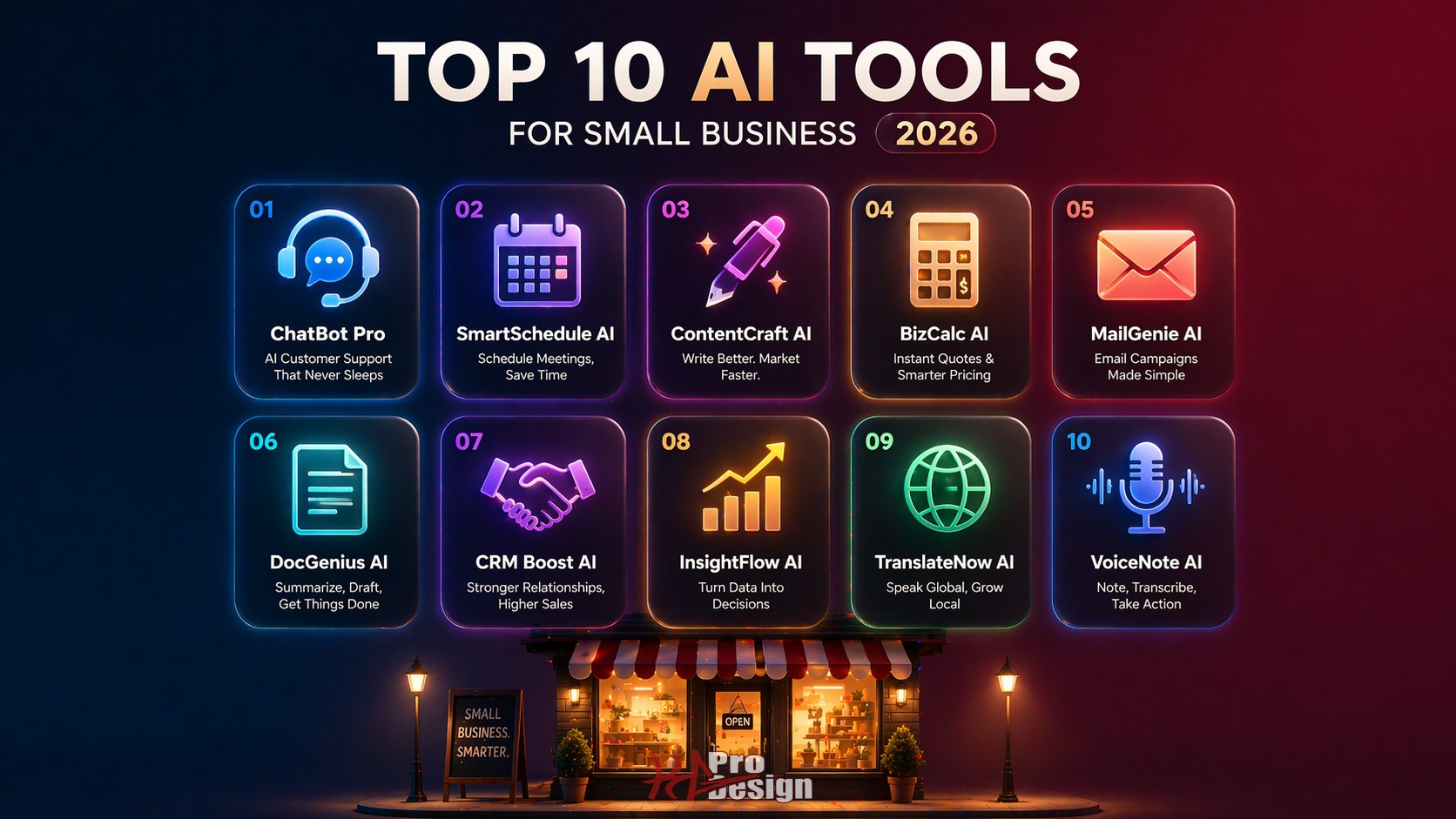
- Good for common use cases (see our roundup of the top 10 AI tools for small businesses)
Option C: Hybrid
- Use platforms for standard tasks
- Custom development for differentiators
Step 3: Partner with Experts
AI/ML projects require specialized expertise:
- Data scientists
- ML engineers
- Domain experts
- Integration specialists
Conclusion
AI-powered automation is no longer optional for competitive businesses. The key is starting with practical, high-ROI applications rather than pursuing AI for its own sake.
Focus on:
- Clear business problems with measurable impact
- Available data to train models
- Incremental implementation starting with pilots
- Continuous improvement through monitoring and retraining
The businesses winning with AI in 2026 aren't necessarily the ones with the most sophisticated models—they're the ones solving real problems and delivering measurable value.
Ready to Explore AI Automation?
At KG ProDesign, we help businesses identify and implement practical AI automation solutions that deliver real ROI.
Our approach:
- Start with business outcomes, not technology
- Pilot projects to prove value before scaling
- Full-stack expertise from data to deployment
Contact us to discuss how AI automation can transform your business.