Introduction
You have an idea for an application that could transform your industry, solve a problem you have experienced firsthand, or create a business you have been dreaming about for years. There is just one obstacle: you are not a developer, and you have never built software before.
You are not alone. Some of the most successful software companies in history were founded by people who could not write a line of code. What separated the successful non-technical founders from the ones who burned through their savings and ended up with nothing was not technical skill. It was understanding how to navigate the development process, make informed decisions about technology, and manage a build without being the one writing the code.
This guide is written from the perspective of someone who has been on the other side of that relationship for nearly two decades. We have worked with dozens of non-technical founders, and we have seen the patterns that lead to successful launches and the mistakes that lead to expensive failures. Everything in this article is designed to help you avoid the second outcome and achieve the first.
Before You Write a Single Line of Code
The most expensive line of code is one written before you have validated the idea behind it. Before engaging a developer, investing in design, or even choosing a technology stack, you need to answer three fundamental questions.
Validate Your Idea First
The assumption that your idea is good because you believe in it is natural but dangerous. The market does not care about your conviction. It cares about whether your product solves a real problem that people will pay to have solved.
Talk to potential users. Not friends and family who will tell you what you want to hear. Talk to twenty or more people who match your target customer profile. Ask them about the problem your app would solve. Ask how they currently handle it. Ask what they have tried. Ask what they would pay for a better solution. Listen more than you pitch.
Create mockups and wireframes. Before spending money on development, create visual representations of your app. Tools like Figma, Balsamiq, and even hand-drawn sketches on paper can communicate your vision clearly enough to test with potential users. Show people what the app would look like and how it would work. Watch their reactions. Note where they get confused, excited, or skeptical.
Test willingness to pay. Interest is not the same as demand. People will tell you an idea sounds great and then never open their wallets. Create a landing page that describes your product, includes pricing, and has a signup or waitlist button. Drive traffic to it through targeted ads. If people will not even sign up for a waitlist, they will not pay for the product when it is built.
The goal of validation is not to prove your idea is perfect. It is to prove that enough demand exists to justify the investment in building it.
Define Your MVP (Minimum Viable Product)
The concept of an MVP is widely understood and widely ignored. Every founder nods when you explain that they should build the smallest useful version of their product first. Then they hand you a requirements document with forty-seven features.
An MVP is not a stripped-down version of your full vision. It is a focused product that does one thing well enough that people will use it and give you feedback. Everything else, every nice-to-have feature, every advanced workflow, every integration with a third-party platform, belongs in version two or later.
Here is a practical exercise. Write down every feature you want your app to have. Now sort them by how essential they are to the core user experience. Draw a line after the top three to five features. Everything above the line is your MVP. Everything below the line is a future phase.
This discipline is difficult because every feature feels essential when you are imagining your product. But launching with thirty features means thirty things that can break, thirty things that need testing, thirty things that need documentation, and thirty things that delay your launch date. Launching with five features means you are in users' hands faster, learning faster, and iterating based on real data rather than assumptions.
For a detailed breakdown of what different levels of application complexity cost, see our article on the true cost of building a web app in 2026.
Set a Realistic Budget
The most common budgeting mistake non-technical founders make is anchoring to the lowest estimate they receive and then being shocked when the actual cost exceeds it. Here is a more honest approach.
Get three to five estimates from qualified teams. If the estimates vary wildly, that is a signal that either your requirements are ambiguous or some of the teams are not understanding the scope. Revisit your requirements and ensure they are specific enough that competent teams can agree on what they are estimating.
Budget for development, design, hosting, maintenance, and marketing. Development is the largest line item, but it is not the only one. You need design work, hosting infrastructure, ongoing maintenance after launch, and a way to get users to your product. A common allocation for a first-year budget is 50 to 60 percent development, 10 to 15 percent design, 5 to 10 percent infrastructure, 10 percent maintenance reserve, and 10 to 15 percent marketing.
Apply the contingency rule. Whatever your initial estimate is, plan for it to cost 50 to 100 percent more. This is not pessimism. It is realism based on industry data showing that software projects consistently exceed initial estimates due to scope changes, discovered complexity, and the natural learning curve of a first-time product build. If your budget cannot absorb a 50 percent overrun, your scope is too ambitious for your resources.
Choosing a Development Partner
This decision will determine the trajectory of your project more than any technology choice, feature prioritization, or design decision. Choose carefully.
Freelancer vs. Agency vs. Technical Cofounder
Freelancer. Lower hourly cost, but you bear the project management burden. If the freelancer gets sick, takes another project, or disappears, you have no backup. Freelancers work well for small, well-defined projects where the scope is unlikely to change.
Agency. Higher cost, but you get a team with established processes, project management, quality assurance, and backup capacity. If one developer is unavailable, the agency can reassign someone else. Agencies are better suited for projects with complexity, compliance requirements, or timelines that cannot afford a single point of failure.
Technical cofounder. The highest cost option if you are giving up equity, but you get a partner who is invested in the long-term success of the product, not just the initial build. Finding the right technical cofounder is extremely difficult, and the wrong one can be worse than no technical partner at all.
There is no universally correct choice. The right option depends on your budget, your project's complexity, your risk tolerance, and your ability to manage the development process yourself.
What to Look For
A portfolio of relevant work. Ask to see projects similar to yours in scope, industry, or technology. A developer who has built healthcare applications is better prepared for your healthcare app than one whose portfolio is entirely e-commerce sites, regardless of their overall skill level.
Clear communication. The development process requires frequent communication between you and your team. If a developer is unresponsive during the sales process, they will be unresponsive during development. Pay attention to how quickly they reply, how clearly they explain technical concepts, and how well they listen to your requirements.
A willingness to push back. A good development partner tells you when an idea is technically infeasible, unnecessarily complex, or unlikely to deliver the value you expect. If every response is "yes, we can do that," you are talking to a team that is selling, not consulting. The best partners help you make your product better, even when that means challenging your assumptions.
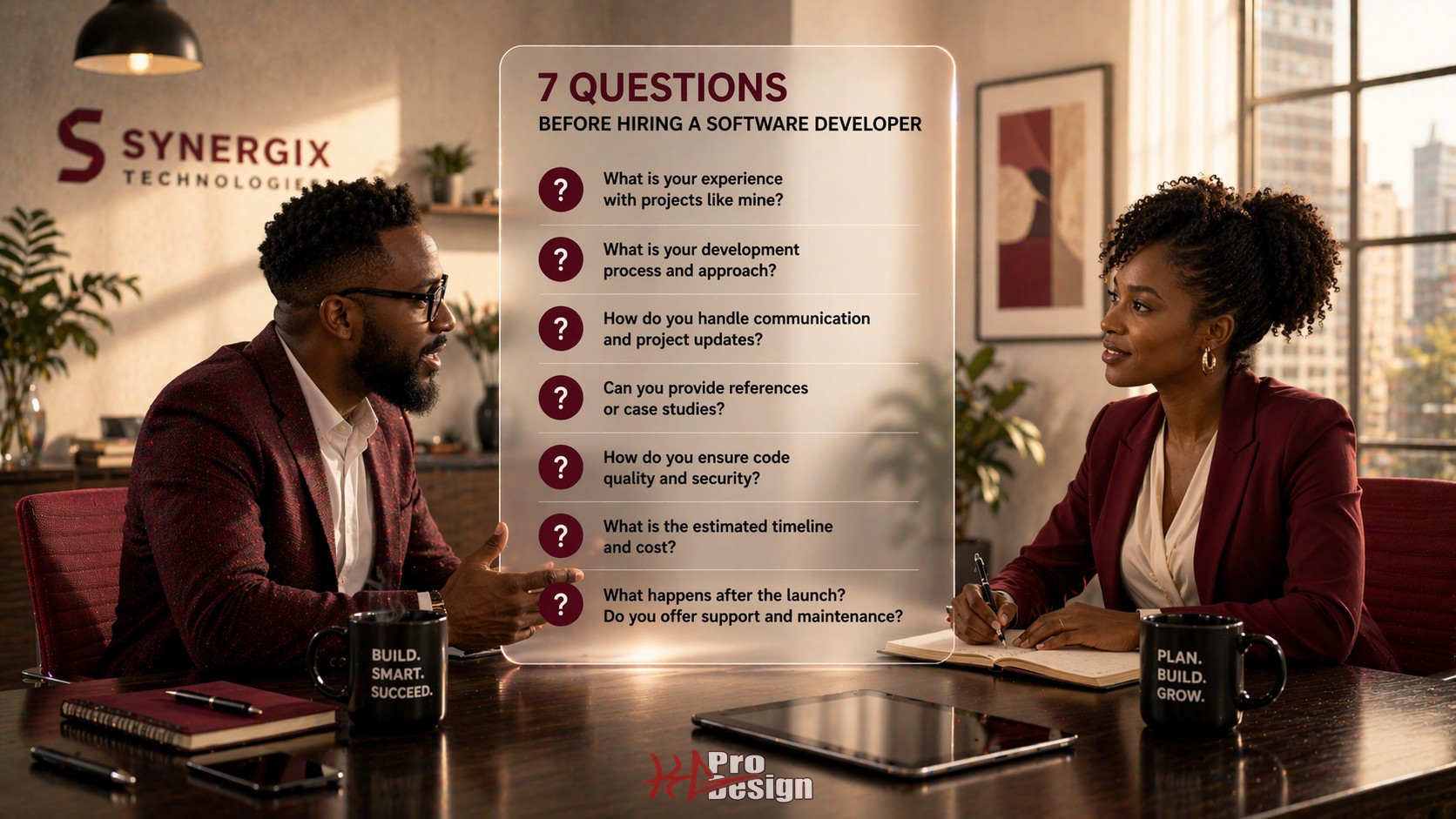
For a deeper dive into vetting potential development partners, our article on 7 questions to ask before hiring a software developer provides a detailed framework.
Red Flags to Watch For
- "We can build anything." Without asking detailed questions about your users, your market, or your business model, this statement is a warning sign. Good developers ask questions before making promises.
- No written proposal or statement of work. If a team is willing to start development without a documented scope, timeline, and cost agreement, they are either inexperienced or counting on scope creep to inflate the project.
- Requesting full payment upfront. Professional development teams work on milestone-based payment schedules. You pay for defined deliverables as they are completed. Full upfront payment removes the incentive for timely delivery and leaves you with no leverage if the work does not meet expectations.
- No process for handling changes. Requirements evolve during development. A team without a defined process for evaluating and pricing changes will either resist all modifications or accept them without adjusting the timeline and budget, both of which lead to problems.
Understanding the Development Process
You do not need to understand code to be an effective product owner. You do need to understand the phases of development and your role in each one.
Discovery and Planning (Weeks 1 to 2)
This phase translates your idea into a buildable specification. The development team will gather requirements, create user stories that describe how each feature works from the user's perspective, produce wireframes showing screen layouts and navigation flows, select the technology stack, and establish a project timeline with milestones.
Your role: Provide clear, detailed answers to every question the team asks. Make decisions promptly. Review wireframes and provide feedback within 24 to 48 hours. Every day of delay during discovery pushes the entire timeline forward.
Design (Weeks 2 to 4)
The design phase creates the visual and interactive experience of your application. UI designers produce screen mockups, define the color palette, typography, and component styles, and create interactive prototypes that simulate the user experience.
Your role: Review designs with your target user in mind, not your personal preferences. If you find yourself saying "I don't like the shade of blue," ask instead, "Will our target user find this trustworthy and easy to use?" Test prototypes with real potential users if possible. Feedback on a prototype is cheap. Feedback after development is expensive.
Development (Weeks 4 to 12+)
The development team builds the application in sprints, typically one- to two-week cycles that each produce working, testable functionality. At the end of each sprint, you should see a demo of what was built and provide feedback.
Your role: Attend every demo. Test every deliverable. Provide feedback promptly and specifically. "This doesn't feel right" is not actionable. "When I click Add to Cart, I expected to see a confirmation message, but the button just goes gray" is actionable. Your engagement during development is the single biggest factor in whether the final product matches your vision.
Launch and Beyond (Ongoing)
Launch is not the finish line. It is the starting line. After deployment, you will monitor real user behavior, gather feedback, fix issues that only appear under real-world conditions, and plan the next set of features based on evidence rather than assumption.
Your role: Resist the urge to launch a version 2 immediately. Observe how real users interact with your product for at least four to six weeks before deciding what to build next. The features you thought were most important may turn out to be rarely used, while a seemingly minor feature may become the thing users love most.
Common Mistakes Non-Technical Founders Make
We have watched these patterns play out across dozens of projects. Learning from other founders' mistakes is significantly cheaper than making your own.
Building too many features in version one. We covered this earlier, but it bears repeating because it is the most common and most expensive mistake. Every additional feature in your MVP increases development time, testing complexity, and the risk that you launch with a mediocre product that does many things poorly rather than a focused product that does one thing well.
Not getting a written contract. Verbal agreements and handshake deals feel efficient but provide no protection. A written contract should specify the scope of work, the timeline, the payment schedule tied to milestones, who owns the code, what happens if the project is cancelled, and how changes to scope are handled. If your development partner resists a written contract, find a different partner.
Disappearing during development. Your development team needs your input regularly. When you go silent for two weeks, the team either stops work and waits (wasting time) or makes assumptions about your preferences and keeps building (risking rework). Stay engaged. Respond to messages within a business day. Attend scheduled meetings.
Expecting perfection on launch day. Software is released, not finished. Your version one will have rough edges, missing features, and minor bugs. This is normal and expected. The goal of launch is to get the product in front of real users, not to deliver a flawless experience. Perfection is achieved iteratively through multiple releases, not through a single heroic development cycle.
Forgetting about post-launch costs. Hosting, maintenance, security updates, and customer support are ongoing expenses. If your budget covers development but leaves nothing for the first year of operations, you will launch a product you cannot afford to run.
How to Be a Great Non-Technical Founder
The most successful non-technical founders we have worked with share several characteristics that you can cultivate regardless of your technical background.
Learn the vocabulary, not the code. You do not need to write JavaScript, but you should understand what an API is, what a database does, what frontend and backend mean, and what deployment involves. This knowledge lets you participate in technical conversations without being the expert and helps you ask better questions.
Be decisive. Delayed decisions delay launches. When your team presents options, evaluate them based on the information available and make a choice. A good decision made today is almost always better than a perfect decision made two weeks from now. You can course-correct later. You cannot recover lost time.
Trust your team's technical recommendations. You hired experts for a reason. When your developer recommends PostgreSQL over MongoDB or suggests cutting a feature to hit the launch date, listen to the reasoning before pushing back. Your expertise is in the business problem and the user. Their expertise is in the technology. The best products emerge from the intersection of both perspectives.
Focus on user problems, not technical solutions. Your job is to articulate the problem clearly and describe what success looks like from the user's perspective. Your development team's job is to determine the technical approach. "Our users need to schedule appointments quickly from their phones" is a great requirement. "Build a React-based scheduling widget with WebSocket real-time updates" is your developer's job to specify.
Ready to Start Building?
Building your first application is one of the most exciting and challenging endeavors you will undertake as a founder. The right preparation, the right partner, and the right expectations make the difference between a product that launches successfully and a project that drains your resources without reaching the market.
At KG ProDesign, we specialize in working with founders and business owners who have a clear vision but need a technical partner to bring it to life. Our consulting services are designed to help you navigate the decisions covered in this article, from idea validation through technology selection to launch planning.
Get started with a conversation about your project, or contact us to schedule a free consultation. We will give you an honest assessment of your idea, your timeline, and your budget, whether or not we end up being the right team for the job.