Introduction
Choosing a POS system is one of the biggest technology decisions a restaurant owner makes. It affects every transaction, every shift, and every customer interaction. Switch to the wrong system and you are stuck with it for years -- literally, given the contract terms some providers require.
KG ProDesign is an independent web development firm. We do not sell, resell, or exclusively partner with any POS vendor. We build custom restaurant websites that integrate with all major POS systems. This comparison is based on publicly available pricing, owner feedback, and industry research -- not on commission incentives or vendor partnerships.
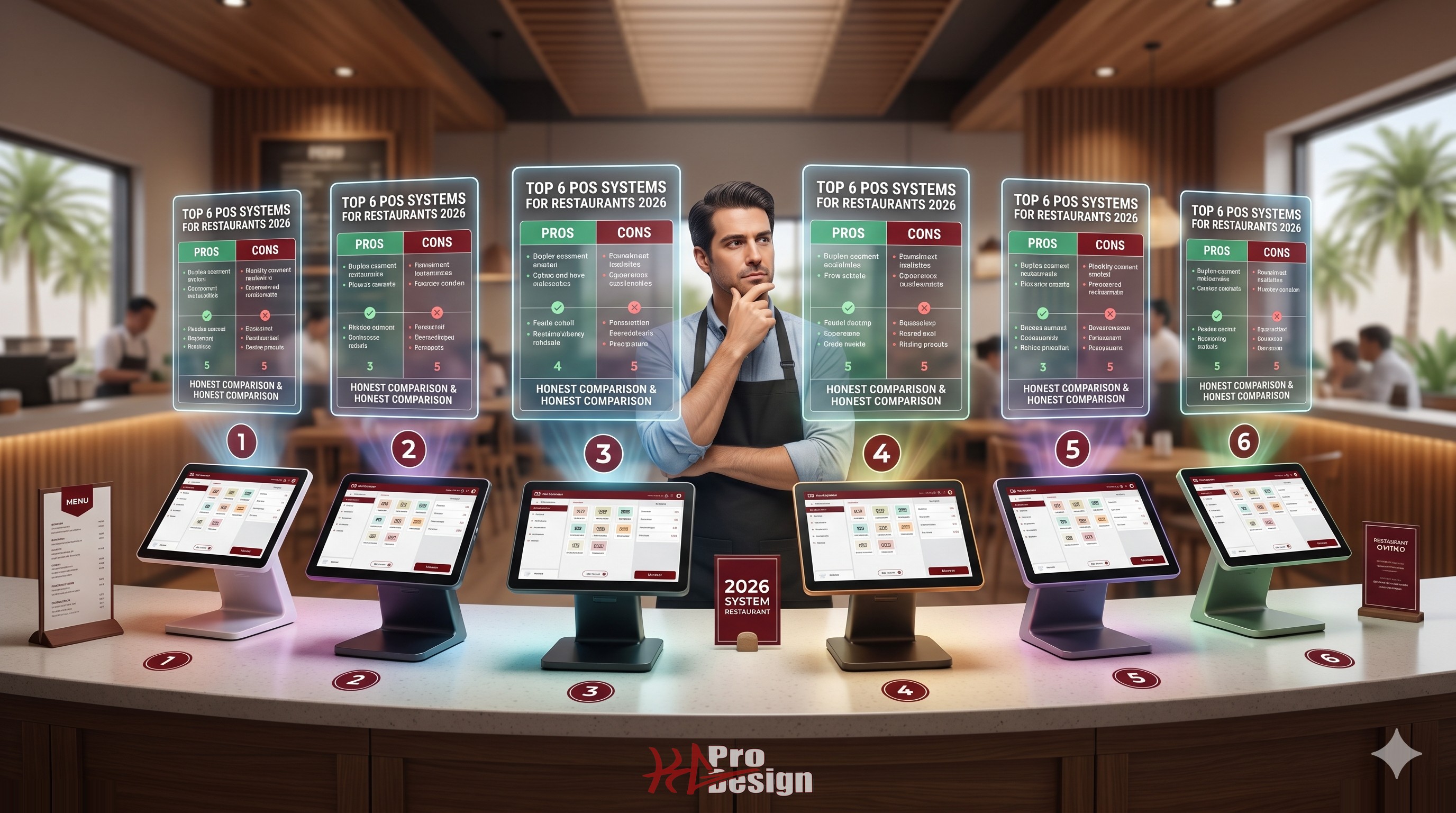
We work with restaurants running every system on this list. That gives us a practical perspective on how each one performs in the real world, not just in a demo environment. This article breaks down the six most popular restaurant POS systems across the categories that actually matter: pricing transparency, hardware costs, contract terms, restaurant-specific features, customer satisfaction data, and web integration capabilities.
How We Evaluated These Systems
We scored each POS system across six categories on a 1-5 scale. Here is what each category measures:
- Usability: How intuitive the system is for staff training and daily operations
- Online Ordering: Quality and flexibility of built-in online ordering features
- Customer-Facing Features: Loyalty programs, gift cards, customer engagement tools, pay-at-table
- Pricing and Transparency: Monthly costs, processing rates, hidden fees, total cost of ownership
- Hardware and Reliability: Terminal quality, uptime, warranty coverage, durability
- Scalability: Multi-location support, enterprise features, growth path
We also considered publicly available customer satisfaction data from Evercore ISI, G2, Capterra, and industry publications. Where specific data points are cited, the source is noted.
The 6 POS Systems Compared
1. Toast
Monthly Cost: $0/month (Starter plan) or $69/month+ (Growth and above)
Processing Rate: 3.09% + $0.15 on Starter plan; custom rates on higher tiers (typically 2.49-2.99% + $0.15)
Hardware Cost: $0 starter kit (limited to one terminal) or $609-$1,339 for hardware bundles
Contract: 2-3 year terms are standard
Fully Loaded Monthly Cost: $300-700+/month when configured with online ordering, loyalty, marketing, and multiple terminals
What Makes It Stand Out: Toast has built the largest restaurant-specific technology ecosystem in the market. Their third-party integration marketplace is extensive, their reporting tools are among the best available, and their Android-based hardware is purpose-built for restaurant environments. If you need a POS that connects to specialized inventory management, advanced reservation systems, or complex accounting integrations, Toast likely has a solution.
Where It Falls Short: The $0/month Starter plan is a loss leader. Processing rates on that plan are higher than competitors, and critical features are locked behind the $69+/month tiers. By the time you add online ordering, loyalty, marketing tools, and a second terminal, you are looking at $300-700+ per month. The 2-3 year contract means you are committing to those costs for a long time. Hardware is Android-only, which limits flexibility.
Best For: Growing full-service restaurants that need extensive integrations and are willing to pay for the broadest ecosystem.
2. SkyTab (by Shift4)
Monthly Cost: $29.99/month
Processing Rate: 2.75% + $0.15 per transaction
Hardware Cost: $0 upfront with lifetime warranty
Contract: 1 year
Customer Satisfaction: 4.29/5.0 (Evercore ISI survey) with 93% merchant retention rate
What Makes It Stand Out: SkyTab's pricing model is the most straightforward on this list. At $29.99/month with $0 hardware cost and a lifetime warranty, the total cost of ownership is lower than any competitor. The 1-year contract is the shortest standard commitment available. Built-in features -- online ordering, loyalty, guest WiFi, pay-at-table -- come included at no extra charge, while competing systems charge additional monthly fees for these modules.
The customer satisfaction numbers speak for themselves. A 4.29/5.0 rating from the Evercore ISI survey is the highest among major restaurant POS providers, and the 93% retention rate indicates that restaurants overwhelmingly choose to stay with the system after trying it.
Where It Falls Short: The mandatory Shift4 payment processing at 2.75% + $0.15 means you cannot shop for lower rates. High-volume restaurants may find this rate above what they could negotiate independently. The integration marketplace is smaller than Toast's, and the platform is newer, which means a smaller user community and fewer third-party resources. Some owners report occasional freezing during peak periods.
Best For: Cost-conscious independent restaurants that want modern features without high upfront costs or long-term contracts.
See what a custom restaurant website integrated with SkyTab looks like at skytab-demo.kgprodesign.com.
3. SpotOn
Monthly Cost: $0/month (basic) or $55/month (full-featured Restaurant plan)
Processing Rate: 2.89% + $0.25 on the free plan; 1.99% + $0.25 on paid plans
Hardware Cost: Approximately $500-$850 per station; $995 fee applies if you later switch away from SpotOn's payment processing to another processor
Contract: Flexible terms, no long-term commitment required
What Makes It Stand Out: SpotOn is one of the few major POS providers that emphasizes 24/7 human support -- not chatbots, not automated phone trees, actual people. For restaurant owners who have been burned by poor support from other providers, that commitment is a genuine differentiator. The paid plan's processing rate of 1.99% + $0.25 is competitive, and the platform offers strong restaurant-specific features including labor management, menu management, and reporting.
Where It Falls Short: The $995 processing switch fee (charged if you move away from SpotOn's payment processing) and hardware costs of approximately $500-$850 per station are significant upfront costs that dampen the appeal of the otherwise flexible pricing. Brand recognition is lower than Toast or Square, which means fewer online resources and community forums when troubleshooting. The integration ecosystem is smaller than Toast's, though it covers the most common restaurant needs.
Best For: Restaurants that prioritize human support and fair pricing, especially those frustrated by chatbot-only support from their current provider.
4. Square for Restaurants
Monthly Cost: $0/month (Free plan) or $49/month (Plus plan)
Processing Rate: 2.6% + $0.15
Hardware Cost: $0 for a basic card reader; $149-$799 for tablet stands and terminals
Contract: No contract -- cancel anytime
What Makes It Stand Out: Square is the easiest POS system to set up. You can create an account, connect a card reader to your phone, and start taking payments in under an hour. The zero-contract model means zero risk. Processing rates are transparent and non-negotiable -- you know exactly what you are paying. The mobile POS is excellent for food trucks, pop-ups, and catering operations. The free plan includes basic online ordering at no additional cost.
Where It Falls Short: Square was designed as a general-purpose payment platform, not a restaurant-specific system. The free plan's restaurant features are limited -- basic reporting, no advanced table management, and a cloud-dependent kitchen display system that requires a reliable internet connection. Reporting for multi-location operations is weak compared to Toast or SpotOn. Square has also been known to freeze merchant accounts without warning for suspected unusual activity, which is a serious risk for any restaurant.
Best For: New and small restaurants, food trucks, and quick-service operations that want the lowest possible barrier to entry.
5. NCR Aloha
Monthly Cost: Custom pricing (typically $100-200/month)
Processing Rate: Custom negotiated rates
Hardware Cost: Approximately $1,000+ per terminal
Contract: Multi-year terms are standard
Installation Base: 75,000+ restaurant locations (including Chipotle, Wendy's, and other major chains)
What Makes It Stand Out: NCR Aloha is the enterprise standard. With 75,000+ locations running the platform, it has proven scalability that no other system on this list can match. Deep customization options, enterprise-grade reporting, and a feature set designed for multi-location restaurant groups and franchises make it the default choice for large operations. If you are running 20+ locations, Aloha is likely already on your shortlist.
Where It Falls Short: This is not a system for independent restaurants. The custom pricing typically requires an enterprise sales process, the hardware costs are high, multi-year contracts are standard, and the setup complexity demands professional installation. The interface feels dated compared to newer systems like Toast and SkyTab. For a single-location restaurant doing $1-3 million in annual revenue, Aloha is overkill in both cost and complexity.
Best For: Large restaurant groups, franchises, and multi-location chains that need enterprise-grade scalability.
6. Clover
Monthly Cost: $135-$354/month (restaurant-specific plans)
Processing Rate: 2.3% + $0.10 (lowest in-person rate on this list)
Hardware Cost: $599-$1,799 for restaurant station setups
Contract: 36-month terms are typical
What Makes It Stand Out: Clover hardware is well-designed and visually appealing. Backed by Fiserv (formerly First Data), the platform has institutional stability and a large app marketplace. The 2.3% + $0.10 processing rate is the lowest in-person rate of any system on this list, which matters for high-volume operations. The app marketplace offers a wide range of third-party add-ons for everything from inventory to employee management.
Where It Falls Short: Clover is one of the most expensive options when you add up all costs. Monthly plans of $135-354 are at the top of the market. The 36-month contract locks you in for three years. Users frequently report hidden fees that were not disclosed during the sales process -- this is partly because Clover uses a reseller model, and the quality of the sales experience varies dramatically depending on which reseller you work with. The hardware is proprietary, meaning if you leave Clover, your terminals become paperweights.
Best For: Quick-service and table-service restaurants that process high transaction volumes and can benefit from the lowest in-person processing rate.
Comparison Table
| POS System | Monthly Cost | Processing Rate | Hardware | Contract | Best For |
|---|---|---|---|---|---|
| Toast | $0-$69+/mo | 3.09%+$0.15 (Starter) / Custom | $0-$1,339 | 2-3 years | Growing restaurants needing integrations |
| SkyTab | $29.99/mo | 2.75%+$0.15 | $0 (lifetime warranty) | 1 year | Cost-conscious independents |
| SpotOn | $0-$55/mo | 2.89%+$0.25 / 1.99%+$0.25 | ~$500-$850/station | Flexible | Restaurants wanting human support |
| Square | $0-$49/mo | 2.6%+$0.15 | $0-$799 | None | Small/new restaurants, food trucks |
| NCR Aloha | Custom (~$100-200/mo) | Custom | ~$1,000+/terminal | Multi-year | Large chains and franchises |
| Clover | $135-$354/mo | 2.3%+$0.10 | $599-$1,799 | 36 months | High-volume quick-service |
Overall Ratings
| POS System | Usability | Online Ordering | Customer-Facing | Pricing | Hardware | Scalability | Overall |
|---|---|---|---|---|---|---|---|
| Toast | 4.0 | 4.5 | 4.0 | 2.5 | 4.0 | 5.0 | 4.0 |
| SkyTab | 4.0 | 4.0 | 4.5 | 4.5 | 4.0 | 3.0 | 4.0 |
| SpotOn | 4.0 | 4.0 | 4.0 | 4.0 | 3.5 | 4.0 | 3.9 |
| Square | 5.0 | 3.5 | 3.0 | 4.5 | 3.0 | 3.0 | 3.7 |
| NCR Aloha | 3.5 | 3.0 | 3.0 | 2.0 | 3.5 | 5.0 | 3.3 |
| Clover | 3.5 | 3.0 | 3.5 | 2.5 | 4.0 | 3.5 | 3.3 |
Ratings are on a 1-5 scale. Overall scores are weighted averages across all six categories.
Our Verdict: It Depends (Honestly)
There is no single "best" POS system. There is only the best system for your restaurant, given your size, budget, growth plans, and operational priorities. Here is how we see it:
Co-#1: Toast and SkyTab -- for different reasons. Toast wins on ecosystem depth and scalability. SkyTab wins on cost transparency and total cost of ownership. Both score a 4.0 overall, but they serve different needs. A growing multi-location restaurant with complex integration requirements will get more from Toast. A cost-conscious independent restaurant that values simplicity will get more from SkyTab.
Best Value: SkyTab. When you factor in $0 hardware, a lifetime warranty, $29.99/month subscription, and a 1-year contract, the total cost of ownership is the lowest on this list by a significant margin.
Best Ecosystem: Toast. No other restaurant POS matches Toast's third-party integration marketplace, reporting depth, and community resources.
Easiest Start: Square. Zero commitment, zero contract, and you can be processing payments in under an hour. If you are opening your first restaurant and want to keep things simple, Square lets you start with no risk.
Best Support: SpotOn. 24/7 human support is a real differentiator in an industry where most providers route you through chatbots and automated phone trees.
Best for Enterprise: NCR Aloha. With 75,000+ locations and clients like Chipotle and Wendy's, Aloha is the proven choice for large restaurant groups and franchises.
Most Expensive (Total Cost): Clover. When you add monthly fees ($135-354/month), hardware costs ($599-1,799), and a 36-month contract, Clover has the highest total cost of ownership for most restaurant configurations.
Which POS Is Right for You?
If you are still deciding, here is a quick decision guide:
Choose Toast if you are a growing restaurant that needs the broadest possible integration ecosystem, you do not mind paying more for features, and you are comfortable with a 2-3 year contract. Toast is the Swiss Army knife of restaurant POS systems.
Choose SkyTab if you want the lowest total cost of ownership, you value pricing transparency, and you prefer a shorter contract commitment. SkyTab is the best option for independent restaurants that want modern features without modern prices.
Choose SpotOn if support quality is your top priority and you want competitive pricing without long-term lock-in. If you have been burned by poor customer service from a previous provider, SpotOn's 24/7 human support is worth the premium.
Choose Square if you are a new restaurant, a food truck, or a small operation that needs the simplest possible setup with zero upfront commitment. Square is the lowest-risk entry point into restaurant POS.
Choose NCR Aloha if you operate multiple locations and need enterprise-grade scalability, deep customization, and a POS that is proven at scale with major chains.
Choose Clover if you process high transaction volumes and the 2.3% + $0.10 in-person processing rate makes a material difference to your margins. Just go in with your eyes open about the 36-month contract and total monthly costs.
The Real Question: What Comes After the POS?
Your POS handles transactions. That is its job, and every system on this list does it competently. But your online presence handles something equally important: first impressions, online orders, and customer retention.
No matter which POS you choose, your restaurant needs a professional web presence. We build custom restaurant websites that integrate with all six of the systems reviewed in this article. A custom website gives you:
- Online ordering without commission fees. No DoorDash. No 25% cut. Orders flow directly from your website into your POS.
- Menu management across channels. Update your menu once, and changes push to your website, your POS, and your delivery platforms.
- Customer data ownership. Every online order builds a customer profile you own -- email, order history, preferences -- powering loyalty programs and targeted marketing.
- Brand consistency. Your website reflects your restaurant's identity, not a generic POS template.
- Search visibility. A custom, SEO-optimized website ranks higher in local search results than a POS-generated page, bringing in new customers organically.
If you are dealing with any of the common POS frustrations -- disconnected systems, manual order re-entry, limited reporting -- read our breakdown of the 5 POS pain points every restaurant owner faces and how to solve them. For a real-world example of what custom POS integration delivers, see how one restaurant saved 15 hours per week by connecting their web presence to their POS.
Choosing a POS Is Important -- But It Is Only Half the Equation
Your restaurant's website is where customers discover you, order from you, and decide to come back. The POS handles what happens inside your four walls. Your website handles everything beyond them.
No matter which POS you choose, your restaurant needs a professional web presence that works seamlessly with it. See what we build at skytab-demo.kgprodesign.com, or get in touch to discuss how a custom website can work alongside your POS.
Explore our web design services to learn more about how we approach restaurant web development.